

Independence does not mean doing everything alone.
For an autistic adult or an adult with a learning disability, independence may mean having greater choice, control and confidence in everyday life while receiving the right support where it is needed.
For one person, that might mean learning to prepare their own meals.
For another, it might mean travelling to work, managing a weekly budget, choosing how to spend their free time or moving into their own home with appropriate support.
Every person is different.
That is why good support should not begin with:
“What can’t this person do?”
A better starting point is:
“What does this person want from their life, what can they already do, and what support could help them achieve more?”
CQC’s current approach to services for autistic people and people with a learning disability reflects exactly this principle: support should maximise choice, control and independence, while care should be person-centred and protect dignity, privacy and human rights.
Good Support Should Help a Person Do More With Their Life – Not Simply Do More Things for Them
There is an important difference between helping someone and automatically doing everything for them.
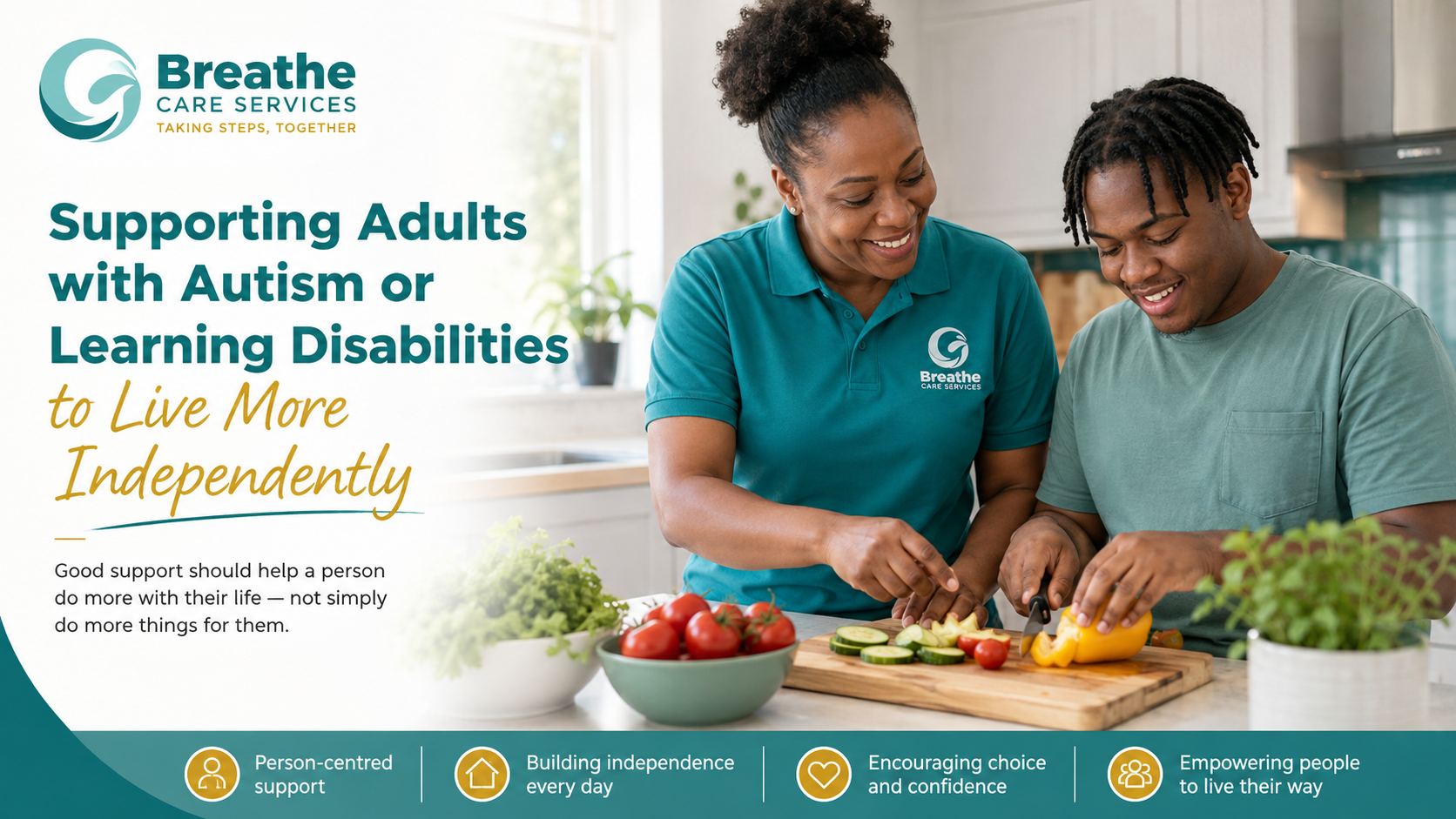
Imagine a young adult who finds cooking difficult.
One approach would be for a support worker to arrive and prepare every meal.
That gets the immediate task completed.
But another approach might involve:
- Choosing meals together
- Creating an accessible shopping list
- Going shopping together
- Learning how to prepare ingredients safely
- Following a simple recipe
- Gradually completing more of the meal independently
The second approach may take more time, but it can help build skills, confidence and greater control.
The aim is not to force independence where support is genuinely needed. Some people will require significant assistance with particular activities, and those needs should be respected.
The principle is to avoid creating unnecessary dependence by taking over things someone could participate in or learn to do with appropriate support.
NHS guidance notes that even people with profound and multiple learning disabilities can still be involved in decisions about themselves, participate in activities they enjoy and exercise independence.
What Does Independent Living Actually Mean?
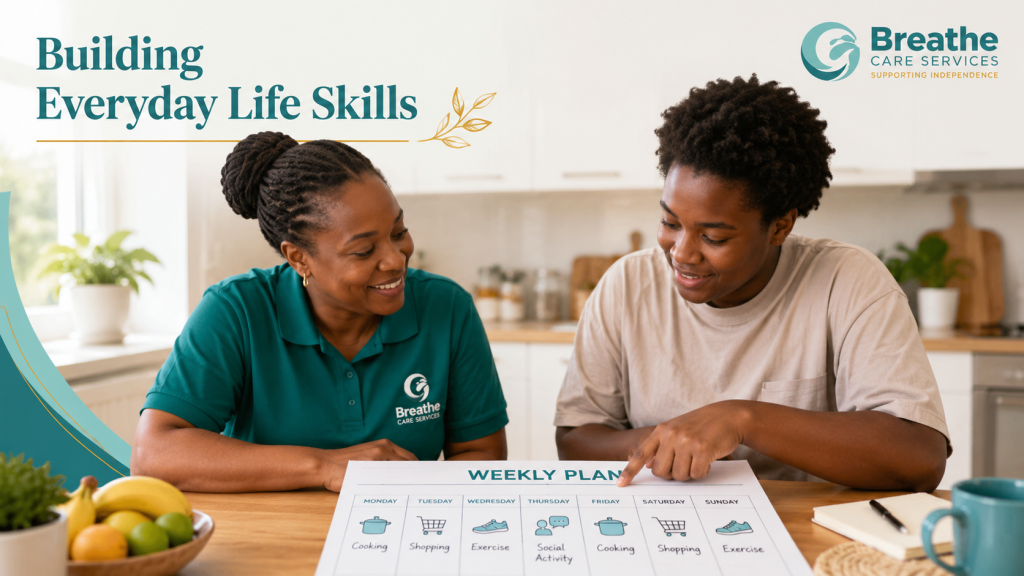
Independent living will look different for every person.
It is not necessarily about living alone.
It may involve having greater control over things such as:
- What time to get up
- What to eat
- What clothes to wear
- Who to spend time with
- How to spend money
- What activities to participate in
- Where to work or volunteer
- How to decorate a home
- What personal goals to pursue
- How support is provided
CQC’s guidance emphasises that people should have meaningful everyday lives, choice and control over their care, and genuine choice about where and with whom they live.
For some people, this may happen while living with family.
For others, it may involve moving into a supported-living arrangement.
The important thing is that support is built around the individual, rather than expecting the individual to fit into a predetermined service.
1. Learning to Cook and Prepare Meals
Cooking is an everyday activity that can involve many different skills:
- Choosing meals
- Planning ingredients
- Writing a shopping list
- Understanding food dates
- Preparing ingredients
- Using kitchen equipment
- Following instructions
- Managing time
- Cleaning afterwards
Someone may be confident in some of these areas and need assistance with others.
Support should therefore be tailored.
One person may need a visual recipe broken into simple steps.
Another may need help using the cooker safely but be perfectly capable of preparing the rest of the meal.
Someone else may initially require extensive support but gradually become more confident.
Rather than automatically preparing every meal for the person, good support looks for appropriate opportunities to prepare meals with them.
Over time, an activity that once required significant support may become something the person can complete with only occasional prompting.
2. Managing Money and Everyday Spending
Money can represent something much bigger than numbers.
It gives people greater control over everyday choices.
Being able to decide:
“I want to buy this.”
“I’m saving for that.”
“I can afford to go out this weekend.”
is part of ordinary adult life.
Depending on the person’s abilities and needs, support might involve:
- Understanding coins and notes
- Using a bank card
- Checking a balance
- Creating a weekly budget
- Planning shopping
- Paying household expenses
- Saving towards something important
- Recognising potential scams
- Understanding the difference between needs and wants
The objective should be appropriate support and safeguards without unnecessarily removing the person’s involvement in their own financial decisions.
For someone who needs substantial assistance, support may be greater. For another person, a weekly budgeting conversation may be sufficient.
3. Shopping With Greater Confidence
A shopping trip involves many independent-living skills at once.
Someone may need to:
- Decide what they need
- Create a list
- Travel to the shop
- Locate items
- Compare choices
- Stay within a budget
- Pay
- Bring everything home
Instead of a support worker simply completing the shopping on someone’s behalf, shopping can become an opportunity to practise decision-making.
The person might choose what they want for dinner, find the ingredients, pay at the till and check their receipt—with assistance where needed.
That is how an ordinary activity can become part of building greater independence.
4. Travelling and Getting Around the Community
Greater independence often depends on being able to get from one place to another.
That might mean travelling to:
- College
- Work
- A volunteering placement
- The shops
- A healthcare appointment
- A leisure activity
- A friend’s home
- A place of worship
- A community group
Some people may always require support when travelling.
Others may be able to learn familiar routes gradually.
Support could involve:
- Planning the journey
- Understanding timetables
- Recognising landmarks
- Practising a route with a support worker
- Learning what to do when a bus is late
- Using maps or travel apps
- Knowing who to contact if something goes wrong
The aim is not necessarily for everyone to travel alone.
It is for each person to have the greatest appropriate level of mobility and community access available to them.
5. Supporting Communication in the Way That Works for the Person
Independence is difficult without a meaningful way to express preferences, needs and choices.
Not everyone communicates in the same way.
An autistic adult or a person with a learning disability may communicate through:
- Speech
- Gestures
- Pictures
- Written information
- Communication cards
- Electronic devices
- Signs
- Behaviour
- Other personalised methods
Good support requires carers to learn how the individual communicates, rather than expecting everybody to communicate in the same way.
For autistic adults in particular, support may also need to take account of predictability, processing time, communication differences and sensory needs. NICE recommends adapting support and communication to the individual and considering structured approaches for autistic adults who need help with activities of daily living.
The more effectively someone can communicate, the more meaningfully they can participate in decisions about their own life.
6. Employment and Volunteering
For many adults, work provides much more than income.
It can provide:
- Routine
- Responsibility
- Confidence
- Skills
- Relationships
- Purpose
- Greater participation in the wider community
Paid employment will not be the right goal for every person.
For others, it may be something they strongly want.
Support might involve:
- Exploring interests
- Developing work-related skills
- Preparing a CV
- Applying for roles
- Practising interviews
- Learning the route to work
- Developing workplace routines
- Understanding workplace expectations
Volunteering may also provide meaningful opportunities for contribution, connection and skill development.
The important point is not to assume in advance what someone can or cannot achieve.
Start with the person’s own ambitions.
7. Building and Maintaining Relationships
Independence should never be confused with isolation.
A meaningful life includes relationships.
People may want:
- Friendships
- Strong family relationships
- Romantic relationships
- Colleagues
- Neighbours
- Faith communities
- Social groups
- People who share their interests
Support should help people develop and maintain meaningful relationships while respecting privacy, dignity and personal boundaries.
That might involve helping someone arrange to meet a friend, participate in a club, stay in touch with relatives or build confidence in social situations.
CQC’s framework for good support specifically emphasises meaningful everyday life, community living and people’s ability to exercise choice and control.
8. Becoming More Involved in the Community
Living in the community is about more than having an address there.
It is about participating.
That might mean:
- Joining a gym
- Playing sport
- Attending a class
- Going to the cinema
- Visiting a library
- Attending church or another place of worship
- Joining a community organisation
- Meeting friends
- Volunteering
- Going to local events
- Visiting cafés or restaurants
Support can help someone discover activities they enjoy and gradually become more confident participating in them.
The goal should not be to create a separate world made entirely of services, support workers and scheduled care activities.
People should have opportunities to participate in ordinary community life according to their interests and preferences.
NHS England’s guidance on supporting autistic people and people with learning disabilities emphasises fulfilling lives, dignity, respect, choice and participation as citizens within their communities.
9. Making Everyday Choices
One of the simplest ways to support independence is also one of the most important:
Let people choose.
What would you like for breakfast?
Which shirt do you want to wear?
Would you rather go shopping this morning or this afternoon?
Do you want to attend this activity?
What would you like your bedroom to look like?
Who would you like involved in your support?
Small choices build a life.
If every decision is made by family members, professionals or support workers because it is quicker or easier, a person can gradually lose meaningful control.
Choice should therefore be built into everyday support wherever possible.
CQC describes strong support for autistic people and people with a learning disability as support that gives people genuine choice and control over how their needs are met.
10. Setting Personal Goals
Support becomes more purposeful when everyone understands what the person wants to achieve.
Goals do not always need to be huge.
Someone’s goals might be:
“I want to cook dinner by myself.”
“I want to travel to college.”
“I want a job.”
“I want to manage my own weekly shopping.”
“I want to make more friends.”
“I want to move into my own home.”
The support plan can then ask:
What can the person already do?
What do they need help with?
What could they learn?
What support would help them progress?
How will we know when progress has been made?
Over time, support should be reviewed as confidence, abilities, circumstances and aspirations change.
What About Supported Living?

For some adults with learning disabilities or autistic adults, supported living can provide an opportunity to have greater control over everyday life while receiving appropriate care and support.
Supported living usually means that the person lives in their own or separately arranged home, while care and support are provided according to their individual needs.
Importantly, in supported living the housing arrangement and care arrangement are generally separate. CQC describes supported-living services as care and support provided in someone’s own home, with housing and care supplied under separate contractual arrangements.
A supported-living arrangement might involve someone living:
- Alone
- With one or more other people
- In rented accommodation
- In another suitable housing arrangement
Support can range considerably.
One person may need only several hours of assistance.
Another may require extensive daily or overnight support.
The defining principle should not be how much support the person receives.
It should be whether that support enables the person to live with as much choice, control and independence as possible.
Moving from the Family Home
For many families, the possibility of an adult son or daughter moving away from home can feel enormous.
Parents may have spent years providing support.
Questions naturally arise:
Will they be safe?
Will someone understand them properly?
What if they need help at night?
Will they eat properly?
Will they be lonely?
Those concerns are understandable.
A transition towards supported living should therefore be carefully planned rather than rushed.
Depending on the person, preparation might involve:
- Visiting the new environment several times
- Meeting support workers
- Creating visual information about the move
- Practising household skills
- Gradually spending longer periods away from the family home
- Establishing familiar routines
- Planning how family relationships will continue
- Clarifying responsibilities between housing and care providers
Some people may be excited about greater independence.
Others may require much more time and reassurance.
The transition should be built around the individual.
Families Still Matter
Supporting greater independence does not mean excluding families.
Parents, siblings and other people who know someone well can hold invaluable knowledge about:
- Communication
- Routines
- Preferences
- Important relationships
- Sensory needs
- Sources of anxiety
- Interests
- Personal history
Where appropriate and with proper regard for the adult’s wishes, rights and confidentiality, good support can involve families while still ensuring that the person receiving support remains at the centre of decisions.
The NHS notes that family members, carers or support workers can assist adults with learning disabilities when engaging with a social-care needs assessment.
The balance is important.
Family involvement should support the person’s life—not replace their voice.
Independence Is Not a Destination
There is no point at which everyone must become “fully independent”.
And there should not be.
All adults depend on other people in different ways.
The question is whether a person has the right support to live the life they want.
For one person, progress might mean making breakfast without assistance.
For another, it might mean choosing their own clothes.
For someone else, it could mean travelling independently to work.
And for another person, independence may mean communicating a choice and having that choice respected while continuing to receive significant physical support.
That progress belongs to the individual.
Start With What the Person Can Do
When support is being planned, it can be tempting to produce a long list of needs:
Needs help cooking.
Needs help travelling.
Needs support communicating.
Needs help managing money.
Those things may all be true.
But there is another useful list to create:
What can this person already do?

Perhaps they can:
- Choose meals
- Prepare some ingredients
- Recognise familiar bus stops
- Use a debit card
- Communicate preferences through pictures
- Complete part of their morning routine
- Travel familiar routes with prompting
- Maintain friendships
- Work several hours each week
Now support can be designed to build from existing strengths, rather than starting with disability alone.
That is the foundation of genuinely person-centred support.
The Best Support Should Become Part of a Bigger Life
A support worker should matter.
A care plan should matter.
A safe home should matter.
But none of those things should become the whole of someone’s identity.
The bigger picture is:
Their home.
Their friendships.
Their work.
Their interests.
Their choices.
Their community.
Their goals.
Their future.
That is why the central principle is worth repeating:
Good support should help a person do more with their life – not simply do more things for them.
Explore Autism, Learning Disability & Supported Living Support
At Breathe Care Services, support is shaped around the individual—their abilities, communication, routines, preferences and personal goals.
Whether someone needs support with everyday living, community participation, greater independence or supported living, the starting point should always be understanding the person and the life they want to build.